
Digital Growth
Client Acquisition Levers: The Hormozi Conversion Playbook
Most businesses do not have a traffic problem. They have an offer problem, a conversion problem, a follow-up problem, or a retention problem. A practical synthesis of the Hormozi-style client acquisition system — offers, traffic levers, conversion, retention, and compounding customer value.
Asset 1
InfographicClient Acquisition Levers — Visual Playbook
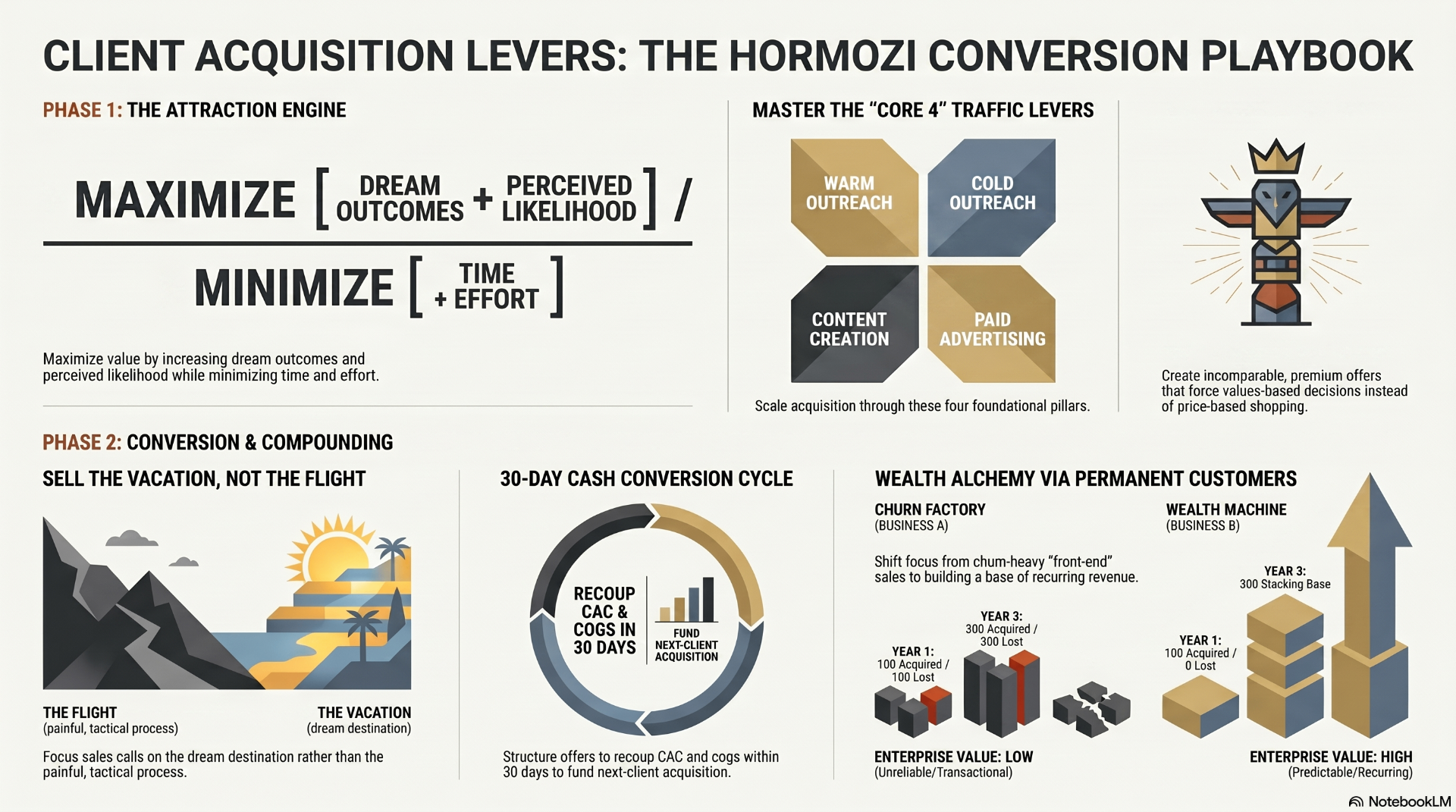
Infographic — A single-page visual covering the attraction engine, value equation, the Core 4 traffic levers, sell-the-vacation conversion, the 30-day cash conversion cycle, and the wealth machine vs churn factory model.
DownloadAsset 2
PresentationHormozi Scaling Blueprint — Presentation
Presentation — Full strategy deck covering client-financed acquisition, the value equation, the Core 4 traffic levers, pitch mechanics, retention, expansion, and a 30-day implementation checklist.
LockedAsset 3
VideoHow to Engineer Client Acquisition — Video
Video — How to engineer client acquisition as a system of levers rather than a single tactic: attention, offer, trust, conversion, fulfilment, retention, expansion.
LockedAsset 4
AudioEight-Figure Client Acquisition Playbook — Audio
Audio — Synthesis walk-through of the eight-figure client acquisition playbook: offer architecture, traffic, conversion, retention, and compounding customer value.
LockedUnlock the Client Acquisition Levers Pack
Get the visual playbook, the Hormozi Scaling Blueprint dossier, and both video synthesis sessions. Free — enter your name and email to unlock.
By submitting, you agree to receive occasional updates from JMacTech. Unsubscribe anytime. Download links expire after 1 hour.
Who & why this matters
Alex Hormozi has become one of the most influential voices in modern offer design, client acquisition, sales systems, and business scaling. The reason his work matters is not because it is motivational — it matters because it is operational.
The strongest parts of the Hormozi acquisition model are built around a few hard commercial questions: Can the offer create enough value to justify a premium price? Can acquisition be funded by the customer rather than by external capital? Can the business generate enough lead volume to make sales skill measurable? Can the conversion process sell the outcome rather than the mechanics? Can customers be retained long enough to compound enterprise value? Can delivery be systemised so the business does not collapse under its own growth?
For JMacTech, this matters because client acquisition is not separate from product strategy. It connects directly to Traffic Engine, App BluePrint, digital growth systems, AI-assisted business building, offer architecture, cyber and AI training products, public authority building, asset-led lead generation, and Build In Public credibility.
Acquisition is not one activity. It is a system of levers. Most businesses pull one lever badly and then blame the market. The stronger approach is to build an acquisition engine where traffic, offer, conversion, cash flow, delivery, retention, and expansion reinforce each other.
Goal
The goal of this report is to translate the Hormozi-style client acquisition model into a practical playbook for founders, consultants, service businesses, AI builders, trainers, and digital operators. The focus is not theory — the focus is implementation.
By the end, you should understand what makes an offer easier to sell, why traffic volume matters more than cleverness, how to use the core four acquisition channels, why speed-to-lead can outperform sales training, why retention matters more than logo acquisition, how permanent customers create enterprise value, and how to turn content and assets into acquisition infrastructure.
TL;DR
Most businesses do not need a more complicated funnel. They need a clearer offer, more volume, faster follow-up, and better retention.
The value equation increases price power by increasing dream outcome and perceived likelihood while reducing time delay and effort. The core four traffic levers are content creation, paid advertising, warm outreach, and cold outreach.
Selling the “vacation” means selling the desired destination, not the painful process required to get there. Client-financed acquisition means structuring offers so the customer funds acquisition and delivery early.
Retention compounds because permanent customers create recurring revenue, lower risk, and stronger enterprise value. The strongest acquisition systems convert attention into trust, trust into action, action into revenue, and revenue into compounding assets.
The core idea
A business scales when it can reliably turn attention into profitable customers and then turn those customers into a permanent base of recurring value. This requires more than marketing — it requires architecture.
A weak business asks: how do I get more leads? A stronger business asks: how do I design an offer, traffic system, conversion process, follow-up mechanism, and retention engine that makes acquisition predictable?
Lead generation without conversion is noise. Conversion without retention is churn. Retention without expansion is under-monetised value. Expansion without delivery systems creates operational failure. The acquisition system has to be designed as a whole.
Phase 1: The attraction engine
The first phase is attraction — where attention is created. But attention by itself is not enough. The market does not reward visibility alone. It rewards visible relevance.
Warm outreach uses existing trust — previous clients, current clients, professional contacts, community members, past prospects, referrals, and people already familiar with your work. It is often underused because it feels less exciting than paid ads or public content. That is a mistake. The easiest person to sell is often someone who already knows your name, understands your competence, or has seen evidence of your work.
Cold outreach creates new conversations where no prior trust exists. It is harder because the market has not granted attention yet. That means the message must be specific. “I help businesses grow” is weak. “I noticed your business is publishing AI content but has no visible cyber safety layer around the tools, prompts, data flows, or customer-facing automations” is specific, and specificity creates relevance.
Content is the long-term trust layer. It allows people to see how you think, what you are building, what you understand, and what you can repeatedly produce. A blog post, video, asset pack, or public progress report is not just content — it is a trust object. For JMacTech, content is not only marketing. Content is infrastructure.
Paid advertising scales attention, but it amplifies whatever is already there. If the offer is weak, ads make the weakness visible faster. The role of paid ads is to scale a message that already converts. The useful sequence is: build the offer, publish proof, create asset packs, capture email, test organic response, and then amplify with paid distribution.
Phase 2: Offer creation
The strongest acquisition systems begin with the offer, not the funnel. A funnel cannot fix a weak offer. A better offer increases conversion before the sales call even begins.
The Hormozi-style value equation can be simplified: increase the dream outcome and perceived likelihood, and reduce the time delay and required effort. The offer becomes more valuable when the customer believes the result is desirable, the result is likely, the result can happen faster, and the result will require less friction from them.
Sell the vacation, not the flight. The flight is the process. The vacation is the destination. Most experts sell the flight because they are proud of the mechanics — modules, calls, worksheets, frameworks, dashboards, implementation steps, technical details. The buyer cares about the destination: fewer mistakes, better decisions, reduced exposure, more confidence, faster implementation, clearer systems, stronger positioning, commercial advantage.
For JMacTech: Traffic Engine helps make attention systematic. App BluePrint helps turn ideas into structured app plans. MyCyber helps reduce personal and small-business cyber exposure. AgentWindow helps increase visibility into AI agent activity. PublicSignal helps turn external signals into useful intelligence. ISO AI Training helps professionals understand AI through governance, risk, and standards. The technical machinery matters, but the buyer needs to understand the destination first.
Phase 3: Conversion
Conversion is not persuasion theatre. Conversion is the process of helping the right person see the right value at the right moment. Do not sell the painful tactical process — sell the destination the customer wants to reach.
In practice, discovery should identify the current pain, the desired outcome, the gap between them, the cost of staying where they are, the value of solving the problem, the risk of inaction, and the simplest next step. Poor sales conversations spend too much time explaining the product. Strong sales conversations diagnose the gap.
For JMacTech, many conversions may not begin with a call. They may begin with a blog post, asset pack, checklist, prompt pack, public build update, LinkedIn post, downloadable PDF, NotebookLM-generated study guide, or cyber safety pack. The blog should not just publish articles — it should create conversion assets. Every strategic article should answer: what useful thing does the reader get next?
Phase 4: Speed-to-lead
Many businesses spend heavily to create interest, then respond slowly once interest appears. That is commercially irrational. If someone fills out a form, requests a pack, asks a question, joins a list, or responds to an offer, the first response window matters. The faster the response, the warmer the context. The slower the response, the more trust decays.
If asset packs become a major part of the blog system, the follow-up should not be passive. A practical sequence: immediate asset delivery email, a short “how to use this” email, a related blog or guide, a relevant app or training pathway, and an optional consultation or community invitation. Without follow-up, asset packs become vanity downloads. With follow-up, they become relationship infrastructure.
Phase 5: Retention and the permanent customer base
Acquisition is expensive when every customer relationship ends quickly. The stronger model is not just to acquire customers — it is to build a permanent customer base. A churn-heavy business has to keep refilling the bucket. A retention-driven business compounds.
Better models include ongoing training cohorts, recurring memberships, asset libraries, paid communities, implementation support, app subscriptions, advisory retainers, certification pathways, and recurring cyber and AI briefings. Retention changes the economics of acquisition: if customers stay longer, the business can afford more to acquire them; if customers expand, the business can invest more in onboarding and support; if customers refer, acquisition cost decreases.
Phase 6: Expansion
Expansion is where the business stops treating each sale as the end of the transaction. A customer who already trusts the business may need a deeper product, a training pathway, a workshop, a diagnostic, a higher-touch service, a related app, a premium asset pack, a certification, a team implementation, or a recurring advisory relationship.
Every offer should sit inside a broader pathway: blog post → free asset pack → email follow-up → introductory guide → low-cost product or workshop → training cohort → app subscription → advisory or enterprise offer. This is not aggressive upselling — it is structured progression. The customer should always have a logical next step.
Phase 7: The STAR delegation lesson
Acquisition growth eventually creates operational pressure. If the founder remains the bottleneck, growth becomes fragile. When someone fails to complete work, ask: did they know what was required, did they know what outcome was expected, did they know how to do it, did they know when it was due, and were they blocked by circumstances or lack of authority?
Many founders mistake unclear delegation for poor attitude. In reality, the system may be unclear. As the JMacTech ecosystem expands across apps, blog content, asset packs, videos, training, community, websites, lead generation, customer follow-up, and product development, the operating system matters. Scaling is making sure the business can deliver without collapsing into founder dependency.
What most people miss
Most people simplify client acquisition into one narrow question: how do I get more leads? That question is incomplete. The better question is: what part of the acquisition system is actually constrained?
The constraint may be unclear positioning, weak offer, poor audience selection, low traffic volume, slow follow-up, poor sales diagnosis, weak proof, unclear guarantee, low trust, bad onboarding, churn, no expansion pathway, or founder bottleneck. More leads will not fix weak conversion. Better sales scripts will not fix a poor offer. Paid ads will not fix weak retention. More content will not fix unclear positioning. Acquisition has to be treated as a system of levers.
Practical 30-day implementation
Week 1 — Offer architecture: define the dream outcome, identify the painful flight the customer wants to avoid, rewrite the offer around the destination, add proof, clarity, and risk reduction, and identify what can be turned into a useful asset.
Week 2 — Traffic discipline: choose one traffic lever to focus on first, publish one high-value synthesis post, create one downloadable asset, run warm outreach to relevant contacts, and start a simple tracking sheet for conversations, downloads, replies, and leads.
Week 3 — Conversion and follow-up: build the asset delivery email, add a short follow-up sequence, create a clear next step after download, improve the article CTA, and review what people clicked, downloaded, or ignored.
Week 4 — Retention and expansion: identify the logical next product or service, create a progression path, add related articles and internal links, design a small recurring offer or training pathway, and document what worked in a public progress report.
Final takeaway
Client acquisition is not one lever — it is a connected system. The useful lesson from the Hormozi conversion playbook is not “do more marketing”. The useful lesson is to engineer the full path: attention → offer → trust → conversion → fulfilment → retention → expansion → enterprise value.
For JMacTech, the website, blog, apps, asset packs, training offers, progress reports, and Build In Public activity should not operate as disconnected pieces. They should operate as one acquisition and trust system. That is the real playbook. Not louder marketing. Better architecture.
Frequently asked questions
- What is the Hormozi value equation in one sentence?
- Maximise the dream outcome and perceived likelihood of success, and minimise the time delay and effort required — the bigger the numerator and the smaller the denominator, the more valuable the offer.
- What are the Core 4 traffic levers?
- Warm outreach, cold outreach, content creation, and paid advertising — the four foundational channels for scaling attention into qualified leads.
- What is client-financed acquisition?
- Structuring offers so the revenue from a new customer recoups customer acquisition cost and cost of goods within roughly 30 days, allowing the next customer's acquisition to be funded from the previous one.
Related app
Traffic Engine
A digital growth infrastructure app for building search visibility, traffic assets, and low-cost web presence systems.
Explore Traffic EngineAbout the author
John Mackenzie writes on cybersecurity, AI, digital systems, governance, risk, and technology-enabled work. He is the founder of JMacTech and JMac Learning.