
Research Library

Research Papers

A structured library view of the six independent JMacTech research papers, their public positioning, and their controlled summary status.

Abstract Cyber Cube governance model showing cyber risk as a dynamic organisational configuration.
Paper 01Cyber Governance ResearchPublic Summary Only

Cyber Cube Theory and the Failure of Cyber Governance

A boardroom and executive-management theory of cyber risk, compliance theatre, defensibility, and reasonable and proportionate cybersecurity.

Cyber Cube Theory reframes cyber failure as an organisational governance state shaped by leadership, evidence, controls, privacy, AI, suppliers, resilience, and assurance quality.

Intentionally not disclosed

Do not publish the full model mechanics, internal scoring logic, transformation-distance logic, or operational implementation method. Keep the public version focused on the governance problem and the high-level theory.
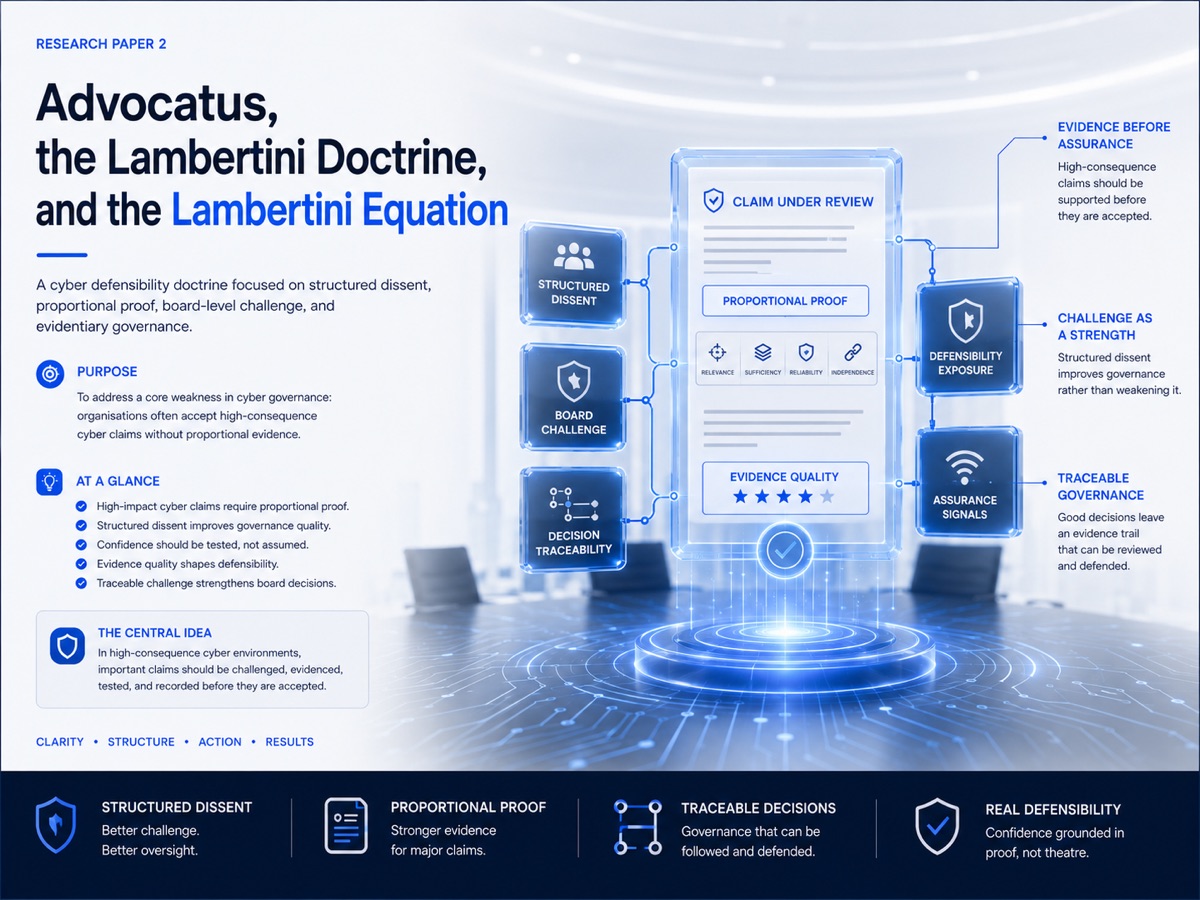
Digital boardroom evidence challenge model for cyber defensibility and proportional proof.
Paper 02Cyber Defensibility DoctrinePublic Summary Only

Advocatus: Institutionalising Evidentiary Governance in Cyber Defensibility

A cyber defensibility doctrine focused on structured dissent, proportional proof, board-level challenge, and evidentiary governance.

Advocatus reframes cyber assurance around board-level challenge, proportional proof, and traceable evidence before material cyber claims are accepted.

Intentionally not disclosed

Do not publish the full equation mechanics, weighting logic, internal domain model, or platform architecture. Public content should focus on the governance principle: high-criticality cyber claims require proportional evidence.

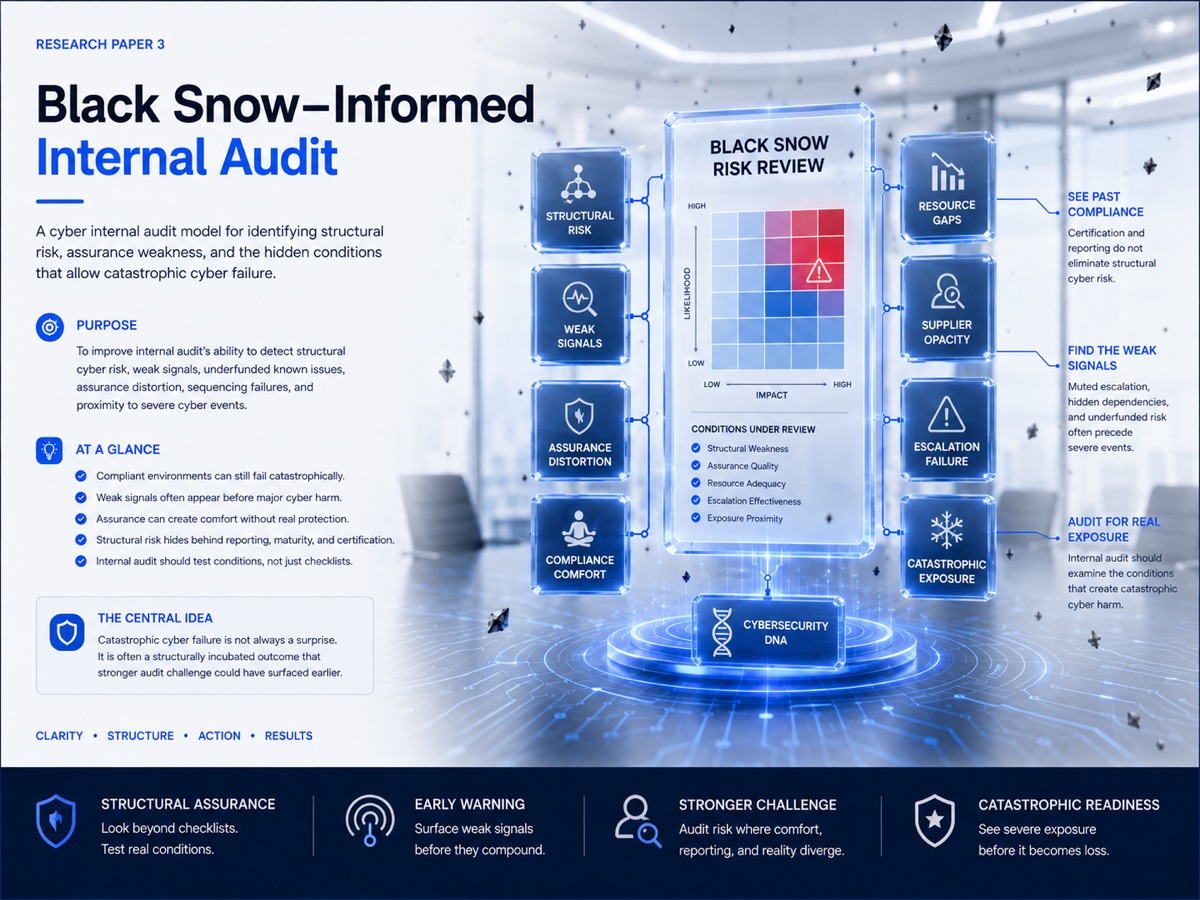
Black Snow internal audit concept showing hidden catastrophic cyber risk inside a compliant environment.
Paper 03Internal Audit and Cyber AssurancePublic Summary Only

Black Snow–Informed Internal Audit

A cyber internal audit model examining why standards-compliant environments can still fail catastrophically.

Black Snow–Informed Internal Audit examines the structural signals that can make compliant environments catastrophically fragile long before a severe cyber event is recognised.

Intentionally not disclosed

Do not publish the full Black Snow indicator set, Cybersecurity DNA profiling detail, Omega Point model, proximity logic, or financial tracing method. Public content should describe the problem and the audit orientation without exposing the operating method.

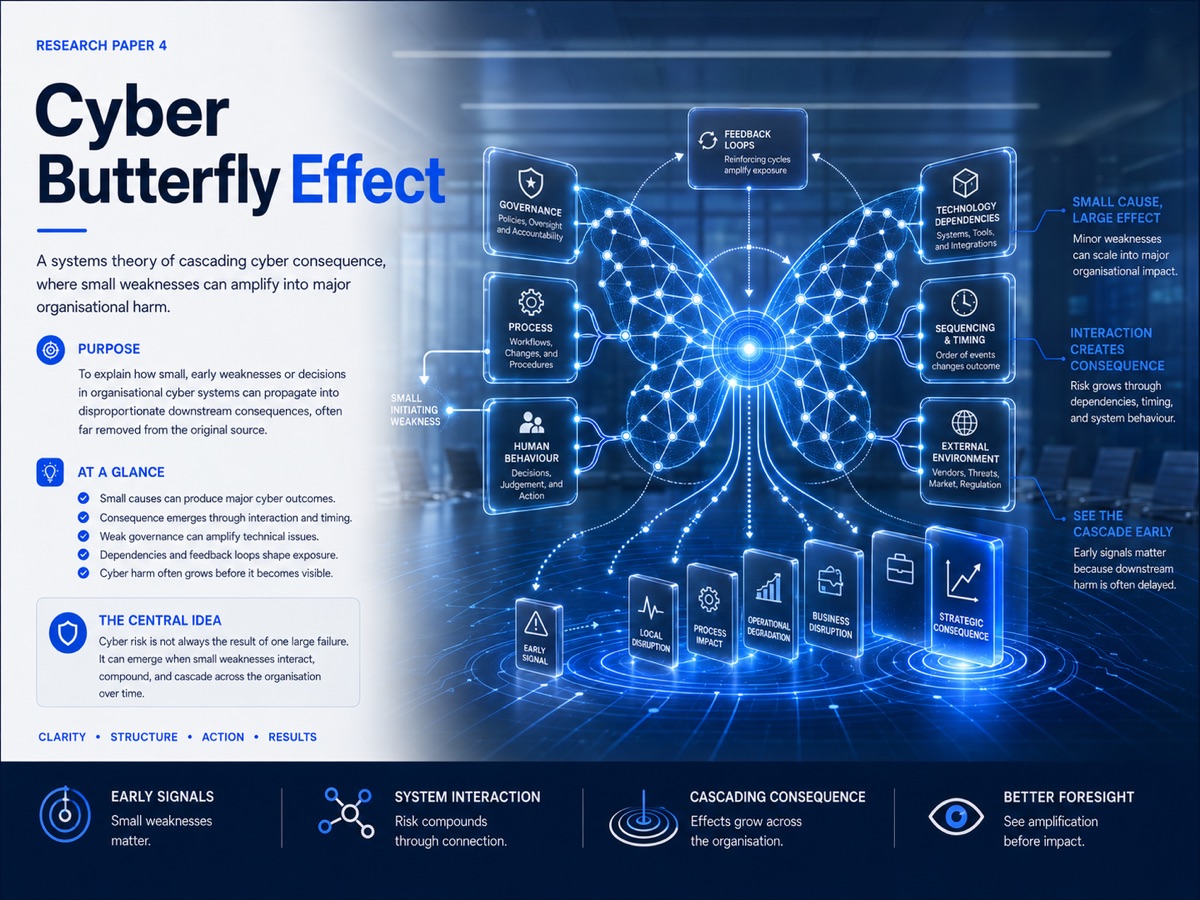
Cyber Butterfly Effect concept showing small tolerated cyber weakness propagating through organisational systems.
Paper 04Cyber Causation TheoryPublic Summary Only

The Cyber Butterfly Effect

A doctrinal, sequential, and literature-grounded model of micro-causation, cyber DNA, and organisational cyber harm.

The Cyber Butterfly Effect tracks how minor tolerated weakness can propagate through organisational systems and compound into material cyber harm.

Intentionally not disclosed

Do not publish the full doctrinal architecture, internal category model, ghost asset analysis method, kill chain detail, or operational diagnostic method. Public content should explain the high-level concept and its value without exposing the full research framework.

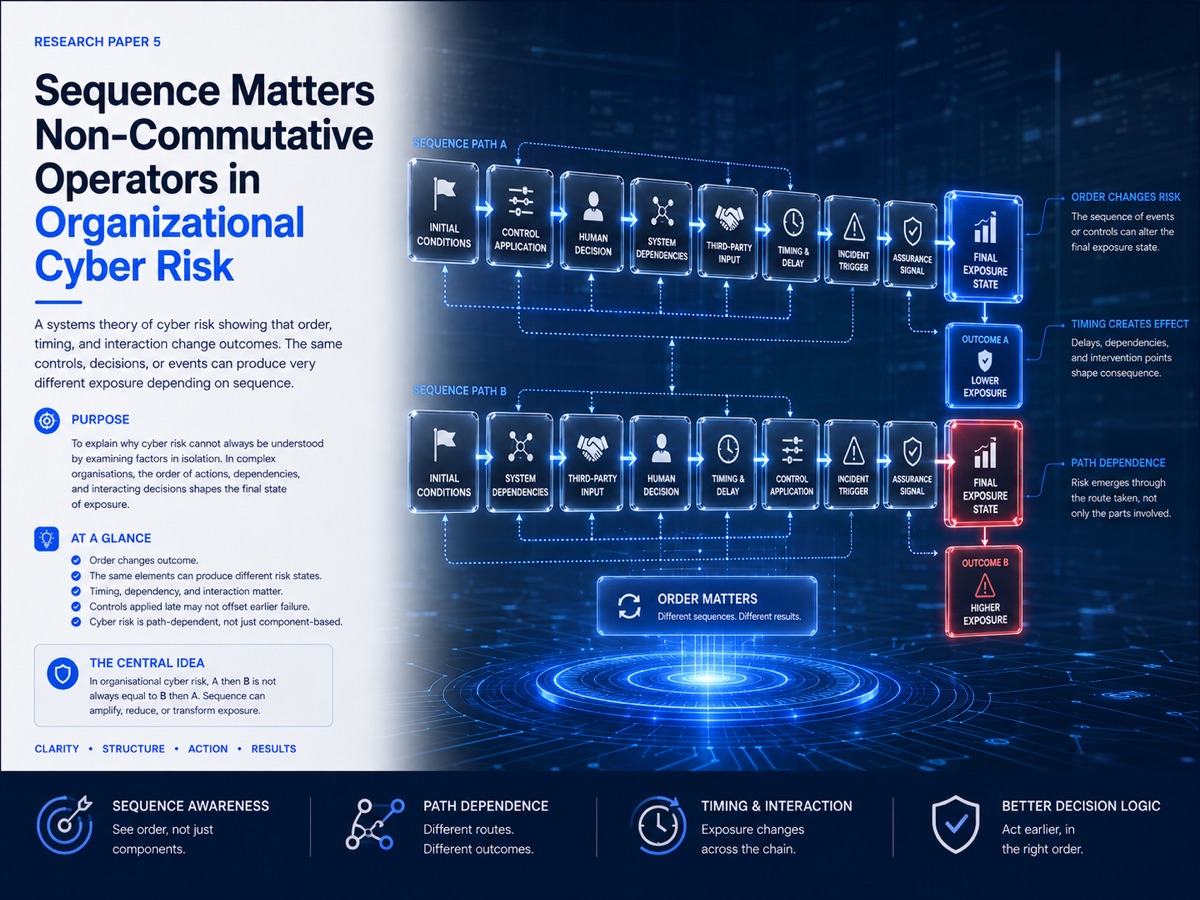
Sequence Matters concept showing different cyber intervention orders creating different organisational risk outcomes.
Paper 05Cyber Risk SequencingPublic Summary Only

Sequence Matters: Non-Commutative Operators in Organisational Cyber Risk

A sequence-aware cyber risk model arguing that the order of cybersecurity interventions materially affects residual risk.

Sequence Matters explains why the same cyber controls can produce different outcomes when introduced in a different order.

Intentionally not disclosed

Do not publish the full operator model, formal representations, testing methodology, or detailed sequence logic. Public content should describe the principle that order matters without giving away the analytical system.

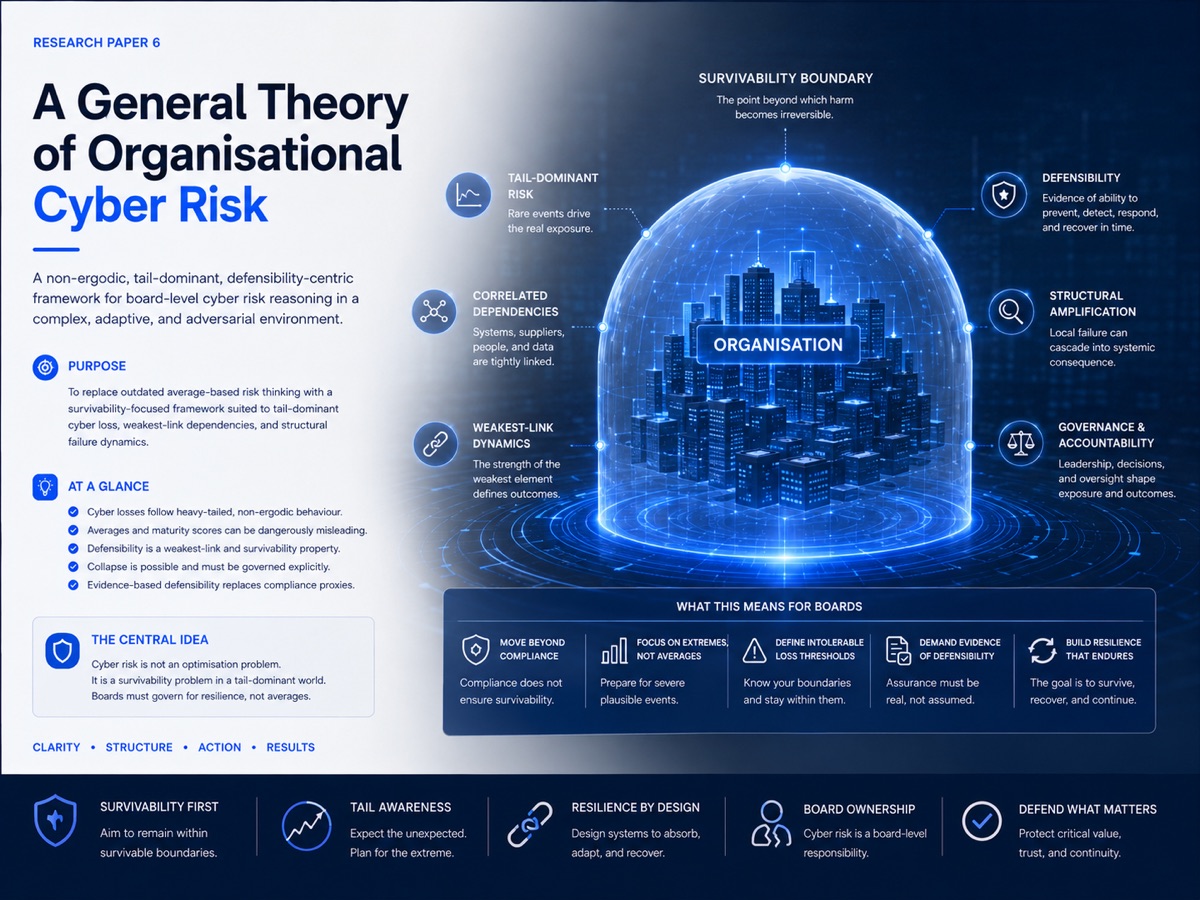
General Theory of Organisational Cyber Risk showing cyber survivability boundaries and defensibility under stress.
Paper 06Cyber Risk TheoryPublic Summary Only

A General Theory of Organisational Cyber Risk

A non-ergodic, tail-dominant, defensibility-centric framework for board-level cyber risk reasoning.

A General Theory of Organisational Cyber Risk reframes cyber risk as a survivability and defensibility problem in a tail-dominant, non-ergodic environment.

Intentionally not disclosed

Do not publish the full mathematical model, survivability identity, internal equations, scoring method, or insurance-pricing implications in operational detail. Public content should explain the shift in thinking without exposing the full theoretical framework.